WE WILL PERFORM IN MEASURE, TIME AND PLACE
The last week of January 2016 was an interesting week for Scotland. It began with Burn’s night on Monday when the birth of Robert Burns was celebrated in Scotland and all over the world. The press also marked the fact that it was 100 days to the next elections for the Scottish parliament and work continues to transfer legislative and fiscal powers to Scotland under the new Scotland Bill 2015. So with all this in mind I thought it would be worth having a look at the ‘Scottish Play’, William Shakespeare’s The Tragedy Of MacBeth.
People have criticised the play over the years for its historical inaccuracies, but we must remember that William Shakespeare was not a historian, he was a playwright whose job it was to produce plays to entertain his audiences. When King James I of England and VI of Scotland became King after the death of Queen Elizabeth I he gave Shakespeare’s acting company, the Chamberlain’s Men, a new title, The King’s Men. This was considered a great honour and they were expected to perform at court whenever required. So, Shakespeare’s play’s not only had to satisfy the scrutiny of the censors, but they had to please the new King and his court as well.
Macbeth was written around 1606 and was probably performed at court that same year. MacBeth is quite a short play and does not have the sub plots which are found in many of the other Shakespeare plays. The main themes running through the plot are ambition, guilt and the supernatural. The existence of witches was a subject in which King James was particularly interested in. He wrote a book about them titled ‘Daemonologie, in Forme of a Dialogue’ published in 1597.
Another theme in the play which I think is just as important, is the subject of succession. Succession had been the subject of much discussion in the later years of Queen Elizabeth’s reign, as she was unmarried and childless. Since 1066, primogeniture, where the right of succession belonged to the first born male child, was used to determine who acceded to the throne in England. Primogeniture has many problems and is nowadays considered discriminatory and was problematic when determining a successor to Elizabeth’s reign. Towards the end of Queen Elizabeth’s reign there were around a dozen potential contenders for the crown. In the end her cousin and nearest relative King James VI of Scotland was crowned King of England and Ireland. This was despite an injunction initiated by King Henry VIII against a Stuart accession.
King James in his theory of monarchy, believed that kings were higher beings than other men. They were chosen by God and that they were God’s representative on Earth. He would have believed strongly in the rules of primogeniture and also that if kings did not follow God’s rules, then ‘wicked’ kings would be punished.
Shakespeare’s MacBeth is a play about the supernatural, about the disruption of the rules of succession and it was also about Scotland, James’s homeland. James in fact only visited Scotland once after becoming King of England and Ireland and moving to England. Perhaps he was acting like the typical Scottish expatriate nowadays who waxes lyrical about his homeland but has no intention of living there and rarely visits.
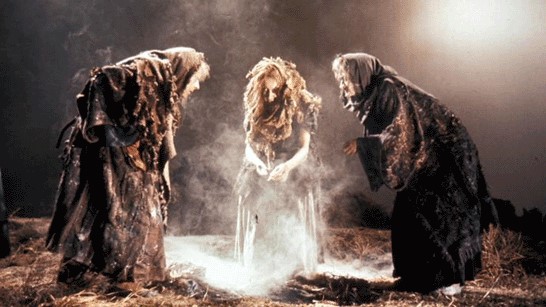
Let’s have a look at the play itself and how the themes of witches and succession are covered. In Act 1 Scene 3 the witches make their second appearance. They meet MacBeth, the Thane of Glamis and his friend Banquo returning victorious from a battle with the Danes.
First Witch: ‘All hail, MacBeth: Hail to thee, Thane of Glamis!’
Second Witch: ‘All hail, MacBeth: Hail to thee, Thane of Cawdor!’
Third Witch: ‘All hail, MacBeth: That shalt be king hearafter!’
MacBeth has received two predictions from the witches and soon after, the first of these becomes true, he hears that King Duncan has made him Thane of Cawdor. MacBeth has gone from someone sceptical of the witches predictions, to someone who believes that this could really will happen. However, his chances of becoming king are soon dispelled in Act1 Scene 4, when King Duncan announces;
‘Sons, kinsmen, thanes,
And you whose places are the nearest, know
We will establish our estate upon
Our eldest, Malcolm, whom we name hereafter
The Prince of Cumberland’
King Duncan has just established primogeniture in Scotland and announced that his eldest son is now heir to the throne. The Prince of Cumberland is a title equivalent to the English title Prince of Wales. (Duncan did not establish primogeniture in Scotland, it was probably established earlier by Malcolm II, but remember, it’s just a story!).
However Lady Macbeth is having none of it, she sees the chance of power and glory and as King Duncan is coming to visit their castle, a plan to murder him is put into place by her, she tells her husband;
‘bear welcome in your eye,
Your hand, your tongue: look like th’innocent flower,
But be the serpent under’t’
In Act 2 MacBeth murders Duncan and sets off a chain of events that lead to more murders and strange happenings throughout the land. King James would recognise King Duncan’s murder as an act against nature and the will of God.
The morning after the murder of the king, it does not get light. Other un-natural things occur like a falcon being killed by an owl, Duncan’s well trained horses went wild and broke out of their stables and killed each other. As Thane Ross says;
‘Gainst nature still:’
Malcolm the heir to the throne flees to England and under the rule of MacBeth there are more murders and chaos in Scotland. Scotland is now being ruled by a ‘wicked’ king.
‘Each new morn
New widows howl, new orphans cry, new sorrows
Strike heaven on the face, that it resounds
As if it felt with Scotland and yelled out
Like syllable of dolour.’
This was MacDuff speaking to the exiled heir to the throne Malcolm in the calm, civilised English royal court. A real contrast to what was happening up north over the border in a chaotic Scotland. They are planning an invasion to kill MacBeth and put Malcolm on the throne and importantly to ensure;
‘A good and virtuous nature may recoil’
Soon an army is raised led by Malcolm, Siward the Earl of Northumberland and supported by MacBeth’s enemies in Scotland. MacBeth is killed and Malcolm will soon be crowned as the new and rightful king of Scotland. So apparently God’s will has been restored and the new king, Malcolm III, can continue to deliver God’s good work on Earth.
‘that calls upon us, by the grace of grace
We will perform in measure, time and place.’
What a terrific rhyming couplet, King James would agree one hundred percent with that.
And what happened to the witches, the Weyard sisters and their boss, Hecate? We don’t know as they do not get a mention after they vanish in Act 4 Scene 1. Persecution of so called witches had been very common under James’s reign in Scotland in particular following the North Berwick witch trials which began in 1590. When he became King James I of England and Ireland in 1603 he had his book Daemonologie republished and persecution in England moved up a gear. In 1604 parliament brought in a new Witchcraft Act which allowed the death penalty to anyone found guilty of invoking evil spirits or communicating with them.
Perhaps MacBeth’s witches were fortunate Shakespeare wrote the play and not James!
Comments are closed.